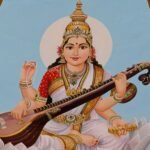
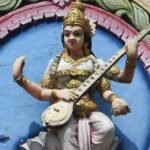
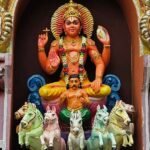
While many Shlokas are tailored to honour a specific deity, Sham no Mitrah Shloka stands out, calling upon various deities collectively to bring forth blessings and auspiciousness.
Originating from the Taittiriya Upanishad, this prayer and its requests are not just for the seeker but for all beings.
The shloka starts by invoking the Gods Mitra, Varuna, Aryaman, Indra, Brihaspati, and Vishnu to be propitious and bring auspiciousness.
Then it invokes the Brahman and Vayu and affirms the commitment to cosmic order and truth. Which makes Sham No Mitrah a unique shloka that not only prays for goodwill but also a vow to the gods to uphold truth and follow the divine order.
Chanting this holy chant with reverence brings the bliss of the Vedic gods, provides protection and promotes peace everywhere.
Om Sham No Mitrah Sham Varunah Shloka Lyrics and Meaning
ॐ शं नो मित्रः शं वरुणः
शं नो भवत्वर्यमा
शं नो इन्द्रो बृहस्पतिः
शं नो विष्णुरुरुक्रमः
नमो ब्रह्मणे
नमस्ते वायो
त्वमेव प्रत्यक्षं ब्रह्मासि
त्वामेव प्रत्यक्षं ब्रह्म वदिष्यामि
ॠतं वदिष्यामि
सत्यं वदिष्यामि
तन्मामवतु
तद्वक्तारमवतु
अवतु माम्
अवतु वक्तारम्
ॐ शान्तिः शान्तिः शान्तिः ॥
Om Śaṁ No Mitraḥ Śaṁ Varuṇaḥ
Śaṁ No Bhavatv Aryamā
Śaṁ No Indro Bṛhaspatiḥ
Śaṁ No Viṣṇur Urukramaḥ
Namo Brahmaṇe
Namaste Vāyo
Tvam Eva Pratyakṣaṁ Brahmāsi
Tvām Eva Pratyakṣaṁ Brahma Vadiṣyāmi
Ṛtaṁ Vadiṣyāmi
Satyaṁ Vadiṣyāmi
Tan Mām Avatu
Tad Vaktāram Avatu
Avatu Mām
Avatu Vaktāram
Om Śāntiḥ Śāntiḥ Śāntiḥ॥
Meaning:
May Mitra (Vedic deity of harmony) be auspicious to us, May Varuna (Vedic deity of cosmic law and order) be auspicious to us
May Aryaman (Vedic deity of customs, protector of stallions and paths of departed souls) be auspicious to us
May Indra (Lord of Devas) and Brihaspati (Guru of Devas) be auspicious to us
May Vishnu (the preserver of the universe), the one with vast strides (wide stepping), be auspicious to us
Salutations to Brahman (the Supreme being)
Salutations to you, O Vayu (Wind god)
You alone are the direct Brahman
I shall proclaim you alone as the directly perceptible Brahman
I shall proclaim the cosmic Law (Ṛta)
I shall proclaim the truth (Satya)
May that protect me
May that protect the speaker (Teacher)
May it protect me
May it protect the speaker
May peace prevail everywhere, trifold from cosmic forces, from other beings and within.
When to Chant this Shloka
Traditionally, the Sham No Mitrah Shloka is recited as a part of the daily routine during morning prayers or Sandhyavandana. However, it can be recited at any point in time.
One can chant this hymn at any time, in need of protection or when one feels anxious or fearful and seeks divine support.
Often, it is also chanted at the beginning of classes, especially for Vedic-related topics, and while practising pranayama or meditation.