Dedicated to Lord Vishnu, Shantakaram Bhujagashayanam is one of the most cherished Vishnu Slokas that brings positivity and blessings of the divine.
Found in the Anushasanika Parva of the Mahabharata, this sacred Sloka gracefully describes the serene appearance of Lord Vishnu, the preserver of the Universe.
It explains the auspiciousness of the form of Lord Vishnu, the divine attributes, and the bestowing nature, along with paying salutations.
The beauty lies not just in the Shantakaram Bhujagashayanam lyrics but also in their profound meaning. Each word in the Sloka has an in-depth meaning, making devotees feel close to Lord Vishnu as it gets recited.
Chanting the Sloka brings a calming effect, filling the surroundings with positivity and bringing spiritual enlightenment and the blessings of Lord Vishnu. Because of its calming effects, the Sloka is commonly chanted during meditation, Yoga, or regular Puja.
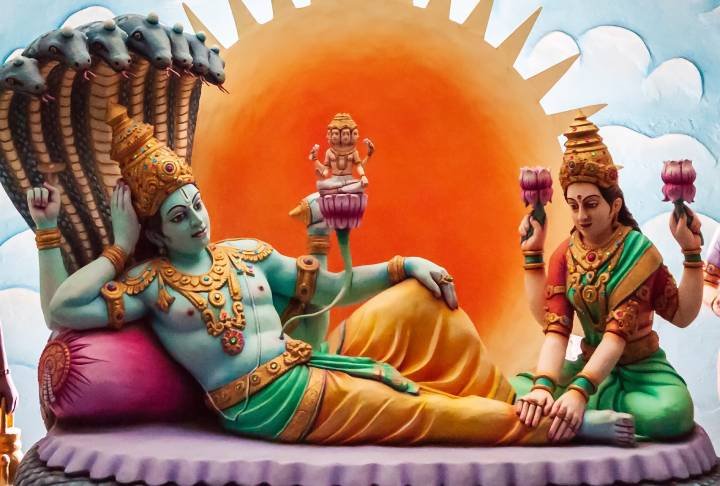
Shantakaram Bhujagashayanam Lyrics and Meaning
शान्ताकारं भुजगशयनं पद्मनाभं सुरेशम्
विश्वाधारं गगनसदृशं मेघवर्णं शुभाङ्गम्।
लक्ष्मीकान्तं कमलनयनं योगिभिर्ध्यान गम्यं
वन्दे विष्णुं भवभय हरं सर्व लोकैक नाथम्॥
Śāntakāraṃ Bhujagaśayanaṃ Padmanābhaṃ Sureśam
Viśvādhāraṃ Gaganasadṛśaṃ Meghavarṇaṃ Śubhāṅgam ।
Lakṣmīkāntaṃ Kamalanayanaṃ Yogibhir Dhyāna Gamyam
Vande Viṣṇuṃ Bhavabhaya Haraṃ Sarva Lokaika Nātham॥
Meaning: The one whose form is the embodiment of peace, who rests upon the serpent (Adisesa), from whose navel the cosmic lotus arose, Lord of all Suras.
O the support of the Universe (indicating sustaining nature), having a form that is vast like the sky, with complexion resembling the colour of clouds, and having the auspicious body parts like limbs (indicating the bestowing nature)
The beloved lord of Goddess Lakshmi, whose eyes resemble the lotus and who is attainable by the yogi through meditation.
I bow to that Lord Vishnu, the remover of worldly fears and the lord of all the worlds.
Word-by-Word Meaning of Santakaram Sloka
Although many devotees chant Vishnu Mantras and Slokas, understanding the Shantakaram Bhujagashayanam meaning word by word brings an entirely new level of clarity about Lord Vishnu.
It helps you visualise the divine form of Lord Vishnu each time you recite it, deepening your connection. Let us explore the meaning one word at a time.
- Shantakaram – Peaceful form (it is a combination of two words, Shanta and Akaram, where Shanta means Peace, Akaram means form)
- Bhujaga Shayanam – Resting on a serpent (Bhujaga – Serpent, Sayanam – Sleeping)
- Padma Nabham – Having a navel that holds a Lotus (Padma – Lotus, Nabham – in the Navel)
- Suresham – Lord of Suras
- Viswadharam – Support of the Universe (Viswa – Universe, Adharam – support)
- Gagana Sadrusam – Vast like Sky (indicating the form, Gagana – Sky, Sadrusam – Vast like)
- Megha Varnam – Cloudy complexion
- Shubhangam – Auspicious body
- Lakshmi Kantam – Husband of Goddess Lakshmi
- Kamala Nayanam – Lotus-eyed (Kamala – Lotus, Nayanam – eyes)
- Yogibhir – By the Yogis
- Dhyana Gamyam – Reached through the Meditation (Dhyana – Meditation, Gamyam – destination)
- Vande – My salutations
- Vishnum – To Lord Vishnu
- Bhava Bhaya – Worldly fears
- Haram – Remover
- Sarva lokaika – One in all the worlds (Sarva – all, Loka – World, aika – One)
- Natham – Supreme Lord
Shantakaram Bhujagashayanam Benefits
Chanting the Shantakaram Bhujagashayanam Sloka offers several spiritual and mental benefits. One of the most important aspects is the sense of peace it brings and the divine protection it invokes.
When recited several times, it shows a gentle yet powerful influence on the mind and body.
It nurtures the faith in the chanting person, provides inner harmony, and spiritual upliftment.
When recited daily, devotees also feel guided and supported during the uncertain times by the grace of Lord Vishnu.